PAPER - I
| |||
| Fundamentals of Sociology | |||
1. Sociology - The Discipline
(a) Modernity and social changes in Europe and emergence of sociology. (b) Scope of the subject and comparison with other social sciences. (c) Sociology and common sense.
2. Sociology as Science
(a) Science, scientific method and critique. (b) Major theoretical strands of research methodology. (c) Positivism and its critique. (d) Fact value and objectivity. (e) Non- positivist methodologies.
3. Research Methods and Analysis
(a) Qualitative and quantitative methods. (b) Techniques of data collection. (c) Variables, sampling, hypothesis, reliability and validity.
4. Sociological Thinkers
(a) Karl Marx- Historical materialism, mode of production, alienation, class struggle. (b) Emile Durkheim- Division of labour, social fact, suicide, religion and society. (c) Max Weber- Social action, ideal types, authority, bureaucracy, protestant ethic and the spirit of capitalism. (d) Talcolt Parsons- Social system, pattern variables. (e) Robert K. Merton- Latent and manifest functions, conformity and deviance, reference groups (f) Mead - Self and identity.
5. Stratification and Mobility
(a) Concepts- equality, inequality, hierarchy, exclusion, poverty and deprivation (b) Theories of social stratification- Structural functionalist theory, Marxist theory, Weberian theory. (c) Dimensions - Social stratification of class, status groups, gender, ethnicity and race. (d) Social mobility- open and closed systems, types of mobility, sources and causes of mobility.
6. Works and Economic Life
(a) Social organization of work in different types of society- slave society, feudal society, industrial /capitalist society. (b) Formal and informal organization of work (c) Labour and society.
7. Politics and Society
(a) Sociological theories of power (b) Power elite, bureaucracy, pressure groups, and political parties. (c) Nation, state, citizenship, democracy, civil society, ideology. (d) Protest, agitation, social movements, collective action, revolution.
8. Religion and Society
(a) Sociological theories of religion. (b) Types of religious practices: animism, monism, pluralism, sects, cults. (c) Religion in modern society: religion and science, secularization, religious revivalism, fundamentalism.
9. Systems of Kinship
(a) Family, household, marriage. (b) Types and forms of family. (c) Lineage and descent (d) Patriarchy and sexual division of labour (e) Contemporary trends.
10. Social Change in Modern Society
(a) Sociological theories of social change. (b) Development and dependency. (c) Agents of social change. (d) Education and social change. (e) Science, technology and social change. | |||
PAPER - II
| |||
| Indian Society: Structure and Change | |||
| A. Introducing Indian Society
(i) Perspectives on the study of Indian society
(a) Indology (GS. Ghurye). (b) Structural functionalism (M N Srinivas). (c) Marxist sociology ( A R Desai).
(ii) Impact of colonial rule on Indian society
(a) Social background of Indian nationalism. (b) Modernization of Indian tradition. (c) Protests and movements during the colonial period. (d) Social reforms
B. Social Structure
(i) Rural and Agrarian Social Structure
(a) The idea of Indian village and village studies- (b) Agrarian social structure - evolution of land tenure system, land reforms.
(ii) Caste System
(a) Perspectives on the study of caste systems: GS Ghurye, M N Srinivas, Louis Dumont, Andre Beteille. (b) Features of caste system. (c) Untouchability - forms and perspectives
(iii) Tribal communities in India
(a) Definitional problems. (b) Geographical spread. (c) Colonial policies and tribes. (d) Issues of integration and autonomy.
(iv) Social Classes in India
(a) Agrarian class structure. (b) Industrial class structure. (c) Middle classes in India.
(v) Systems of Kinship in India
(a) Lineage and descent in India. (b) Types of kinship systems. (c) Family and marriage in India. (d) Household dimensions of the family. (e) Patriarchy, entitlements and sexual division of labour.
(vi) Religion and Society
(a) Religious communities in India. (b) Problems of religious minorities.
C. Social Changes in India
(i) Visions of Social Change in India
(a) Idea of development planning and mixed economy. (b) Constitution, law and social change. (c) Education and social change.
(ii) Rural and Agrarian transformation in India
(a) Programmes of rural development, Community Development Programme, cooperatives, poverty alleviation schemes. (b) Green revolution and social change. (c) Changing modes of production in Indian agriculture . (d) Problems of rural labour, bondage, migration.
(iii) Industrialization and Urbanisation in India
(a) Evolution of modern industry in India. (b) Growth of urban settlements in India. (c) Working class: structure, growth, class mobilization. (d) Informal sector, child labour (e) Slums and deprivation in urban areas.
(iv) Politics and Society
(a) Nation, democracy and citizenship. (b) Political parties, pressure groups , social and political elite. (c) Regionalism and decentralization of power. (d) Secularization
(v) Social Movements in Modern India
(a) Peasants and farmers movements. (b) Women's movement. (c) Backward classes & Dalit movement. (d) Environmental movements. (e) Ethnicity and Identity movements.
(vi) Population Dynamics
(a) Population size, growth, composition and distribution. (b) Components of population growth: birth, death, migration. (c) Population policy and family planning. (d) Emerging issues: ageing, sex ratios, child and infant mortality, reproductive health.
(vii) Challenges of Social Transformation
(a) Crisis of development: displacement, environmental problems and sustainability. (b) Poverty, deprivation and inequalities. (c) Violence against women. (d) Caste conflicts. (e) Ethnic conflicts, communalism, religious revivalism. (f) Illiteracy and disparities in education | |||

BEST AND TOP COACHING CENTRE FOR IAS IPS TNPSC BANK SSC RRB SI TET TRB POLICE EXAM COACHING CENTER IN COIMBATORE
Wednesday, December 28, 2016
SYLLABUS FOR SOCIOLOGY

SYLLABUS FOR HISTORY
PAPER - I
| |||
1. Sources
Archaeological sources: Exploration, excavation, epigraphy, numismatics, monuments Literary sources Indigenous: Primary and secondary; poetry, scientific literature, literature, literature in regional languages, religious literature. Foreign accounts: Greek, Chinese and Arab writers. 2. Pre-history and Proto-history Geographical factors; hunting and gathering (paleolithic and mesolithic); Beginning of agriculture (neolithic and chalcolithic). 3. Indus Valley Civilization Origin, date, extent, characteristics, decline, survival and significance, art and architecture. 4. Megalithic Cultures Distribution of pastoral and farming cultures outside the Indus, Development of community life, Settlements, Development of agriculture, Crafts, Pottery, and Iron industry. 5. Aryans and Vedic Period Expansions of Aryans in India. Vedic Period: Religious and philosophic literature; Transformation from Rig Vedic period to the later Vedic period; Political, social and economical life; Significance of the Vedic Age; Evolution of Monarchy and Varna system. 6. Period of Mahajanapadas Formation of States (Mahajanapada): Republics and monarchies; Rise of urban centres; Trade routes; Economic growth; Introduction of coinage; Spread of Jainism and Buddhism; Rise of Magadha and Nandas. Iranian and Macedonian invasions and their impact. 7. Mauryan Empire Foundation of the Mauryan Empire, Chandragupta, Kautilya and Arthashastra; Ashoka; Concept of Dharma; Edicts; Polity, Administration; Economy; Art, architecture and sculpture; External contacts; Religion; Spread of religion; Literature. Disintegration of the empire; Sungas and Kanvas. 8. Post Mauryan Period (Indo-Greeks, Sakas, Kushanas, Western Kshatrapas): Contact with outside world; growth of urban centres, economy, coinage, development of religions, Mahayana, social conditions, art, architecture, culture, literature and science. 9. Early State and Society in Eastern India, Deccan and South India Kharavela, The Satavahanas, Tamil States of the Sangam Age; Administration, economy, land grants, coinage, trade guilds and urban centres; Buddhist centres; Sangam literature and culture; Art and architecture. 10. Guptas, Vakatakas and Vardhanas Polity and administration, Economic conditions, Coinage of the Guptas, Land grants, Decline of urban centres, Indian feudalism, Caste system, Position of women, Education and educational institutions; Nalanda, Vikramshila and Vallabhi, Literature, scientific literature, art and architecture. 11. Regional States during Gupta Era The Kadambas, Pallavas, Chalukyas of Badami; Polity and Administration, Trade guilds, Literature; growth of Vaishnava and Saiva religions. Tamil Bhakti movement, Shankaracharya; Vedanta; Institutions of temple and temple architecture; Palas, Senas, Rashtrakutas, Paramaras, Polity and administration; Cultural aspects. Arab conquest of Sind; Alberuni, The Chalukyas of Kalyana, Cholas, Hoysalas, Pandyas; Polity and Administration; local Government; Growth of art and architecture, religious sects, Institution of temple and Mathas, Agraharas, education and literature, economy and society. 12. Themes in Early Indian Cultural History: Languages and texts, major stages in the evolution of art and architecture, major philosophical thinkers and schools, ideas in Science and Mathematics. 13. Early Medieval India, 750-1200 * Polity: Major political developments in Northern India and the Peninsula, origin and the rise of Rajputs * The Cholas: administration, village economy and society * Indian Feudalism * Agrarian economy and urban settlements * Trade and commerce * Society: the status of the Brahman and the new social order * Condition of women * Indian science and technology 14. Cultural Traditions in India, 750-1200 * Philosophy: Skankaracharya and Vedanta, Ramanuja and Vishishtadvaita, Madhva and Brahma-Mimansa * Religion: Forms and features of religion, Tamil devotional cult, growth of Bhakti, Islam and its arrival in India, Sufism * Literature: Literature in Sanskrit, growth of Tamil literature, literature in the newly developing languages, Kalhan's Rajtarangini, Alberuni's India * Art and Architecture: Temple architecture, sculpture, painting 15. The Thirteenth Century * Establishment of the Delhi Sultanate: The Ghurian invasions - factors behind Ghurian success * Economic, social and cultural consequences * Foundation of Delhi Sultanate and early Turkish Sultans * Consolidation: The rule of Iltutmish and Balban 16. The Fourteenth Century * The Khalji Revolution * Alauddin Khalji: Conquests and territorial expansion, agrarian and economic measures * Muhammad Tughluq: Major projects, agrarian measures, bureaucracy of Muhammad Tughluq * Firuz Tughluq: Agrarian measures, achievements in civil engineering and public works, decline of the Sultanate, foreign contacts and Ibn Battuta's account 17. Society, Culture and Economy in the Thirteenth and Fourteenth Centuries * Society: composition of rural society, ruling classes, town dwellers, women, religious classes, caste and slavery under the Sultanate, Bhakti movement, Sufi movement * Culture: Persian literature, literature in the regional languages of North India, literature in the languages of South India, Sultanate architecture and new structural forms, painting, evolution of a composite culture * Economy: Agricultural production, rise of urban economy and non-agricultural production, trade and commerce 18. The Fifteenth and Early Sixteenth Century - Political Developments and Economy * Rise of Provincial Dynasties: Bengal, Kashmir (Zainul Abedin), Gujarat, Malwa, Bahmanids * The Vijayanagra Empire * Lodis * Mughal Empire, First phase: Babur and Humayun * The Sur Empire: Sher Shah's administration * Portuguese Colonial enterprise * Bhakti and Sufi Movements 19. The Fifteenth and early Sixteenth Century - Society and Culture * Regional cultural specificities * Literary traditions * Provincial architecture * Society, culture, literature and the arts in Vijayanagara Empire. 20. Akbar * Conquests and consolidation of the Empire * Establishment of Jagir and Mansab systems * Rajput policy * Evolution of religious and social outlook, theory of Sulh-i-kul and religious policy * Court patronage of art and technology 21. Mughal Empire in the Seventeenth Century * Major administrative policies of Jahangir, Shahjahan and Aurangzeb * The Empire and the Zamindars * Religious policies of Jahangir, Shahjahan and Aurangzeb * Nature of the Mughal State * Late Seventeenth century crisis and the revolts * The Ahom Kingdom * Shivaji and the early Maratha Kingdom. 22. Economy and Society in the Sixteenth and Seventeenth Centuries * Population, agricultural production, craft production * Towns, commerce with Europe through Dutch, English and French companies : a trade revolution * Indian mercantile classes, banking, insurance and credit systems * Condition of peasants, condition of women * Evolution of the Sikh community and the Khalsa Panth 23. Culture in the Mughal Empire * Persian histories and other literature * Hindi and other religious literature * Mughal architecture * Mughal painting * Provincial architecture and painting * Classical music * Science and technology 24. The Eighteenth Century * Factors for the decline of the Mughal Empire * The regional principalities: Nizam's Deccan, Bengal, Awadh * Maratha ascendancy under the Peshwas * The Maratha fiscal and financial system * Emergence of Afghan Power, Battle of Panipat:1761 * State of politics, culture and economy on the eve of the British conquest | |||
PAPER - II
| |||
1. European Penetration into India
The Early European Settlements; The Portuguese and the Dutch; The English and the French East India Companies; Their struggle for supremacy; Carnatic Wars; Bengal -The conflict between the English and the Nawabs of Bengal; Siraj and the English; The Battle of Plassey; Significance of Plassey. 2. British Expansion in India Bengal - Mir Jafar and Mir Kasim; The Battle of Buxar; Mysore; The Marathas; The three Anglo-Maratha Wars; The Punjab. 3. Early Structure of the British Raj The early administrative structure; From diarchy to direct control; The Regulating Act (1773); The Pitt's India Act (1784); The Charter Act (1833); The voice of free trade and the changing character of British colonial rule; The English utilitarian and India. 4. Economic Impact of British Colonial Rule (a) Land revenue settlements in British India; The Permanent Settlement; Ryotwari Settlement; Mahalwari Settlement; Economic impact of the revenue arrangements; Commercialization of agriculture; Rise of landless agrarian labourers; Impoverishment of the rural society. (b) Dislocation of traditional trade and commerce; De-industrialisation; Decline of traditional crafts; Drain of wealth; Economic transformation of India; Railroad and communication network including telegraph and postal services; Famine and poverty in the rural interior; European business enterprise and its limitations. 5. Social and Cultural Developments The state of indigenous education, its dislocation; Orientalist-Anglicist controversy, The introduction of western education in India; The rise of press, literature and public opinion; The rise of modern vernacular literature; Progress of science; Christian missionary activities in India. 6. Social and Religious Reform movements in Bengal and Other Areas Ram Mohan Roy, The Brahmo Movement; Devendranath Tagore; Iswarchandra Vidyasagar; The Young Bengal Movement; Dayanada Saraswati; The social reform movements in India including Sati, widow remarriage, child marriage etc.; The contribution of Indian renaissance to the growth of modern India; Islamic revivalism - the Feraizi and Wahabi Movements. 7. Indian Response to British Rule Peasant movements and tribal uprisings in the 18th and 19th centuries including the Rangpur Dhing (1783), the Kol Rebellion (1832), the Mopla Rebellion in Malabar (1841-1920), the Santal Hul (1855), Indigo Rebellion (1859-60), Deccan Uprising (1875) and the Munda Ulgulan (1899-1900); The Great Revolt of 1857 - Origin, character, causes of failure, the consequences; The shift in the character of peasant uprisings in the post-1857 period; the peasant movements of the 1920s and 1930s. 8. Factors leading to the birth of Indian Nationalism; Politics of Association; The Foundation of the Indian National Congress; The Safety-valve thesis relating to the birth of the Congress; Programme and objectives of Early Congress; the social composition of early Congress leadership; the Moderates and Extremists; The Partition of Bengal (1905); The Swadeshi Movement in Bengal; the economic and political aspects of Swadeshi Movement; The beginning of revolutionary extremism in India. 9. Rise of Gandhi; Character of Gandhian nationalism; Gandhi's popular appeal; Rowlatt Satyagraha; the Khilafat Movement; the Non-cooperation Movement; National politics from the end of the Non-cooperation movement to the beginning of the Civil Disobedience movement; the two phases of the Civil Disobedience Movement; Simon Commission; The Nehru Report; the Round Table Conferences; Nationalism and the Peasant Movements; Nationalism and Working class movements; Women and Indian youth and students in Indian politics (1885-1947); the election of 1937 and the formation of ministries; Cripps Mission; the Quit India Movement; the Wavell Plan; The Cabinet Mission. 10. Constitutional Developments in the Colonial India between 1858 and 1935 11. Other strands in the National Movement The Revolutionaries: Bengal, the Punjab, Maharashtra, U.P, the Madras Presidency, Outside India. The Left; The Left within the Congress: Jawaharlal Nehru, Subhas Chandra Bose, the Congress Socialist Party; the Communist Party of India, other left parties. 12. Politics of Separatism; the Muslim League; the Hindu Mahasabha; Communalism and the politics of partition; Transfer of power; Independence. 13. Consolidation as a Nation; Nehru's Foreign Policy; India and her neighbours (1947-1964); The linguistic reorganisation of States (1935-1947); Regionalism and regional inequality; Integration of Princely States; Princes in electoral politics; the Question of National Language. 14. Caste and Ethnicity after 1947; Backward castes and tribes in post-colonial electoral politics; Dalit movements. 15. Economic development and political change; Land reforms; the politics of planning and rural reconstruction; Ecology and environmental policy in post - colonial India; Progress of science. 16. Enlightenment and Modern ideas (i) Major ideas of Enlightenment: Kant, Rousseau (ii) Spread of Enlightenment in the colonies (iii) Rise of socialist ideas (up to Marx); spread of Marxian Socialism. 17. Origins of Modern Politics (i) European States System. (ii) American Revolution and the Constitution. (iii) French revolution and aftermath, 1789-1815. (iv) American Civil War with reference to Abraham Lincoln and the abolition of slavery. (v) British Democratic Politics, 1815-1850; Parliamentary Reformers, Free Traders, Chartists. 18. Industrialization (i) English Industrial Revolution: Causes and Impact on Society (ii) Industrialization in other countries: USA, Germany, Russia, Japan (iii) Industrialization and Globalization. 19. Nation-State System (i) Rise of Nationalism in 19th century (ii) Nationalism: state-building in Germany and Italy (iii) Disintegration of Empires in the face of the emergence of nationalities across the world. 20. Imperialism and Colonialism (i) South and South-East Asia (ii) Latin America and South Africa (iii) Australia (iv) Imperialism and free trade: Rise of neo-imperialism. 21. Revolution and Counter-Revolution (i) 19th Century European revolutions (ii) The Russian Revolution of 1917-1921 (iii) Fascist Counter-Revolution, Italy and Germany. (iv)The Chinese Revolution of 1949 22. World Wars (i) 1st and 2nd World Wars as Total Wars: Societal implications (ii) World War I: Causes and consequences (iii) World War II: Causes and consequence 23. The World after World War II (i) Emergence of two power blocs (ii) Emergence of Third World and non-alignment (iii) UNO and the global disputes. 24. Liberation from Colonial Rule (i) Latin America-Bolivar (ii) Arab World-Egypt (iii) Africa-Apartheid to Democracy (iv) South-East Asia-Vietnam 25. Decolonization and Underdevelopment (i) Factors constraining development: Latin America, Africa 26. Unification of Europe (i) Post War Foundations: NATO and European Community (ii) Consolidation and Expansion of European Community (iii) European Union. 27. Disintegration of Soviet Union and the Rise of the Unipolar World (i) Factors leading to the collapse of Soviet communism and the Soviet Union, 1985-1991 (ii) Political Changes in Eastern Europe 1989-2001. (iii) End of the cold war and US ascendancy in the World as the lone superpower. | |||
SYLLABUS FOR POLITICAL SCIENCE
PAPER - I
| |||||||
| Administrative Theory | |||||||
Political Theory and Indian Politics
| |||||||
1. Political Theory: meaning and approaches.
2. Theories of the State: Liberal, Neo-liberal, Marxist, Pluralist, Post-colonial and feminist. 3. Justice: Conceptions of justice with special reference to Rawl 's theory of justice and its communitarian critiques. 4. Equality: Social, political and economic; relationship between equality and freedom; Affirmative action. 5. Rights: Meaning and theories; different kinds of rights; concept of Human Rights. 6. Democracy: Classical and contemporary theories; different models of democracy - representative, participatory and deliberative. 7. Concept of power, hegemony, ideology and legitimacy. 8. Political Ideologies: Liberalism, Socialism, Marxism, Fascism, Gandhism and Feminism. 9. Indian Political Thought : Dharamshastra, Arthashastra and Buddhist traditions; Sir Syed Ahmed Khan, Sri Aurobindo, M.K. Gandhi, B.R. Ambedkar, M.N. Roy . 10. Western Political Thought: Plato, Aristotle, Machiavelli, Hobbes, Locke, John S. Mill, Marx, Gramsci, Hannah Arendt. | |||||||
Indian Government and Politics
| |||||||
| 1. Indian Nationalism | |||||||
| |||||||
| 2. Making of the Indian Constitution: Legacies of the British rule; different social and political perspectives. | |||||||
3. Salient Features of the Indian Constitution: The Preamble, Fundamental Rights and Duties, Directive Principles; Parliamentary System and Amendment Procedures; Judicial Review and Basic Structure doctrine.
| |||||||
4. (a) Principal Organs of the Union Government: Envisaged role and actual working of the Executive, Legislature and Supreme Court.
(b) Principal Organs of the State Government: Envisaged role and actual working of the Executive, Legislature and High Courts. | |||||||
5. Grassroots Democracy: Panchayati Raj and Municipal Government; significance of 73rd and 74th Amendments; Grassroot movements.
| |||||||
6. Statutory Institutions/Commissions: Election Commission, Comptroller and Auditor General, Finance Commission, Union Public Service Commission, National Commission for Scheduled Castes, National Commission for Scheduled Tribes, National Commission for Women; National Human Rights Commission, National Commission for Minorities, National Backward Classes Commission.
| |||||||
7. Federalism: Constitutional provisions; changing nature of centre-state relations; integrationist tendencies and regional aspirations; inter-state disputes.
| |||||||
8. Planning and Economic Development: Nehruvian and Gandhian perspectives; role of planning and public sector; Green Revolution, land reforms and agrarian relations; liberalilzation and economic reforms.
| |||||||
9. Caste, Religion and Ethnicity in Indian Politics.
| |||||||
10. Party System: National and regional political parties, ideological and social bases of parties; patterns of coalition politics; Pressure groups, trends in electoral behaviour; changing socio- economic profile of Legislators.
| |||||||
11. Social Movements: Civil liberties and human rights movements; women 's movements; environmentalist movements.
| |||||||
PAPER - II
| |||||||
| Comparative Politics and International Relations Comparative Political Analysis and International Politics: | |||||||
| 1. Comparative Politics: Nature and major approaches; political economy and political sociology perspectives; limitations of the comparative method. | |||||||
| 2. State in comparative perspective: Characteristics and changing nature of the State in capitalist and socialist economies, and, advanced industrial and developing societies. | |||||||
| 3. Politics of Representation and Participation: Political parties, pressure groups and social movements in advanced industrial and developing societies. | |||||||
| 4. Globalisation: Responses from developed and developing societies. | |||||||
| 5. Approaches to the Study of International Relations: Idealist, Realist, Marxist, Functionalist and Systems theory. | |||||||
6. Key concepts in International Relations: National interest, Security and power; Balance of power and deterrence; Transnational actors and collective security; World capitalist economy and globalisation.
| |||||||
7. Changing International Political Order:
(a) Rise of super powers; strategic and ideological Bipolarity, arms race and Cold War; nuclear threat; (b) Nonaligned movement: Aims and achievements; (c) Collapse of the Soviet Union; Unipolarity and American hegemony; relevance of non-alignment in the contemporary world. | |||||||
8. Evolution of the International Economic System: From Brettonwoods to WTO; Socialist economies and the CMEA (Council for Mutual Economic Assistance); Third World demand for new international economic order; Globalisation of the world economy.
| |||||||
9. United Nations: Envisaged role and actual record; specialized UN agenciesaims and functioning; need for UN reforms.
| |||||||
10. Regionalisation of World Politics: EU, ASEAN, APEC, SAARC, NAFTA.
| |||||||
11. Contemporary Global Concerns: Democracy, human rights, environment,gender justice, terrorism, nuclear proliferation.
| |||||||
| India and the World: | |||||||
1. Indian Foreign Policy: Determinants of foreign policy; institutions of policymaking; continuity and change.
| |||||||
2. India 's Contribution to the Non-Alignment Movement: Different phases; currentrole.
| |||||||
3. India and South Asia:
(a) Regional Co-operation: SAARC - past performance and future prospects. (b) South Asia as a Free Trade Area. (c) India 's "Look East" policy. (d) Impediments to regional co-operation: river water disputes; illegal cross-border migration; ethnic conflicts and insurgencies; border disputes. | |||||||
4. India and the Global South: Relations with Africa and Latin America; leadership role in the demand for NIEO and WTO negotiations.
| |||||||
5. India and the Global Centres of Power: USA, EU, Japan, China and Russia.
| |||||||
6. India and the UN System: Role in UN Peace-keeping; demand for Permanent Seat in the Security Council.
| |||||||
7. India and the Nuclear Question: Changing perceptions and policy.
| |||||||
8. Recent developments in Indian Foreign policy: India 's position on the recent crises in Afghanistan, Iraq and West Asia, growing relations with US and Israel; vision of a new world order.
| |||||||
SYLLABUS FOR CSAT
Paper II- (200 marks) Duration: Two hours
- Comprehension
- Interpersonal skills including communication skills;
- Logical reasoning and analytical ability
- Decision-making and problem-solving
- General mental ability
- Basic numeracy (numbers and their relations, orders of magnitude, etc.) (Class X level), Data interpretation (charts, graphs, tables, data sufficiency etc. - Class X level)
- English Language Comprehension skills (Class X level).
Note 1 : Questions relating to English Language Comprehension skills of Class X level (last item in the Syllabus of Paper II) will be tested through passages from English language only without providing Hindi translation thereof in the question paper.
Note 2 : The questions will be of multiple choice, objective type.
Monday, December 26, 2016


Sunday, December 25, 2016

Friday, December 23, 2016
UPSC TNPSC TET SI POLICE E-Books

Shanmugam IAS Study
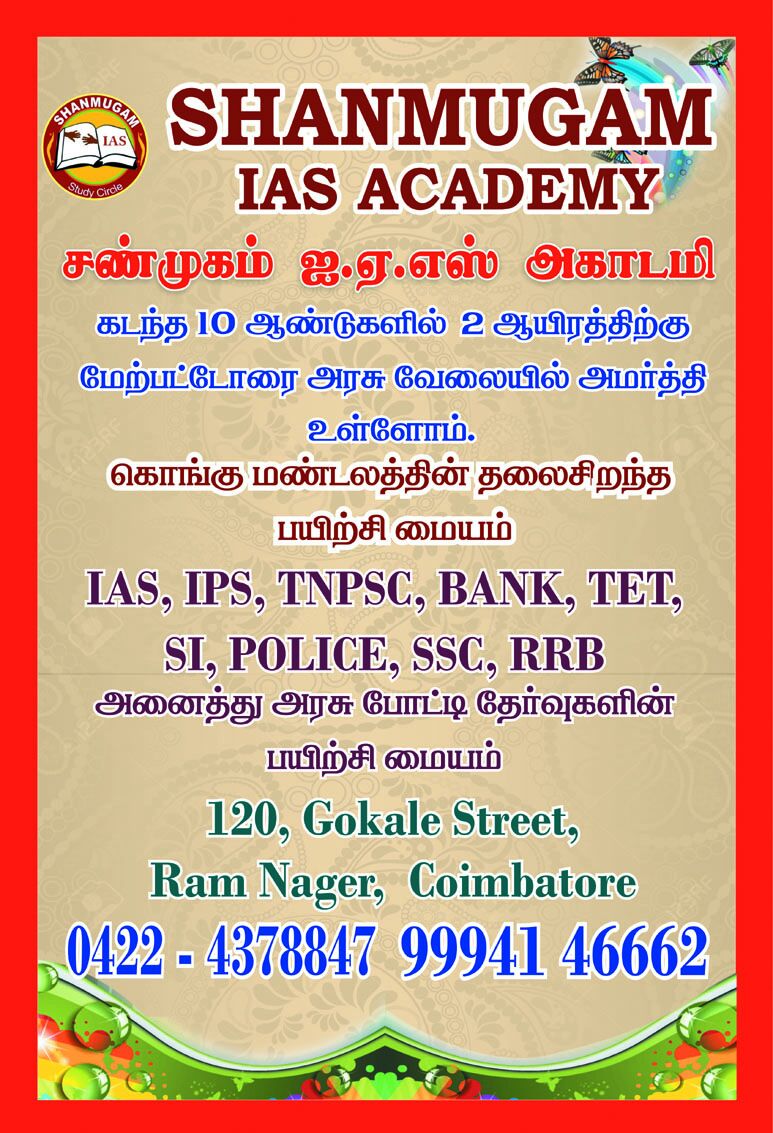
circle is an independent private educational institution. It was established in the Year of 2006 with the
noble cause of training the
civil service aspirants in a focus manner and
preparing them for facing the lands highest examination.
we are steadfastly
committed to quality guidance and holistic training to the IAS IPS IRS TNPSC
GROUP I II& IV, VAO, BANKING, SI, POLICE, TET, TRB Railway and all
competitive aspirants.
Wednesday, December 21, 2016
Government Exam Coaching Centre in Coimbatore

Shanmugam IAS Study
circle is an independent private educational institution. It was established in the Year of 2006 with the
noble cause of training the
civil service aspirants in a focus manner and
preparing them for facing the lands highest examination.
we are steadfastly
committed to quality guidance and holistic training to the IAS IPS IRS TNPSC
GROUP I II& IV, VAO, BANKING, SI, POLICE, TET, TRB Railway and all
competitive aspirants. view more.
IAS IPS Coaching Centre in Coimbatore

Shanmugam IAS Study circle is an independent private educational institution. It was established in the Year of 2006 with the
noble cause of training the
civil service aspirants in a focus manner and
preparing them for facing the lands highest examination.
we are steadfastly
committed to quality guidance and holistic training to the IAS IPS IRS TNPSC
GROUP I II& IV, VAO, BANKING, SI, POLICE, TET, TRB Railway and all
competitive aspirants. view more..
TET Exam Coaching Centre in Coimbatore
Shanmugam IAS Study
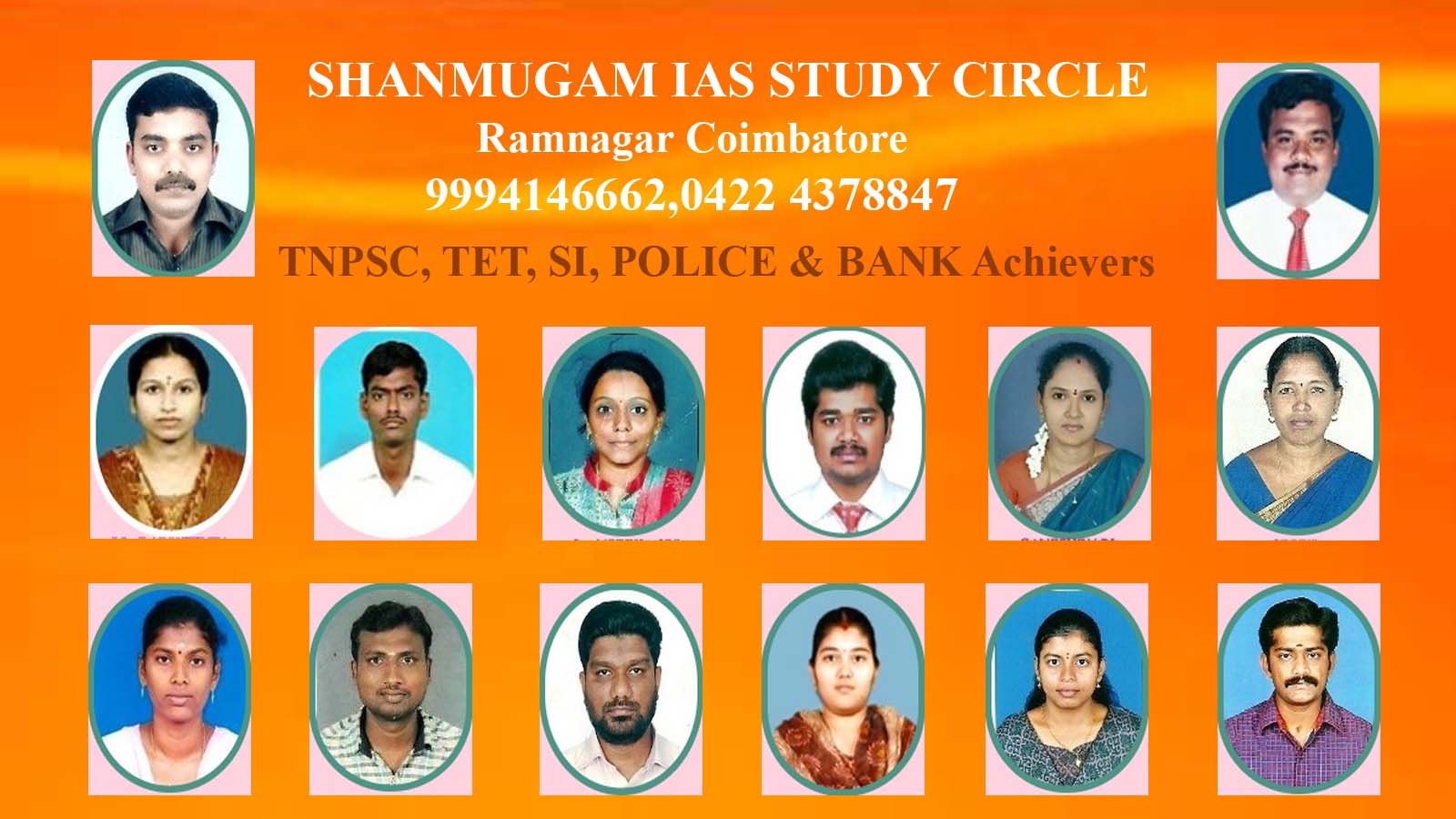
circle is an independent private educational institution. It was established in the Year of 2006 with the
noble cause of training the
civil service aspirants in a focus manner and
preparing them for facing the lands highest examination.
we are steadfastly
committed to quality guidance and holistic training to the IAS IPS IRS TNPSC
GROUP I II& IV, VAO, BANKING, SI, POLICE, TET, TRB Railway and all
competitive aspirants.
Bank Exam Coaching Centre in coimbatore

Shanmugam IAS Study
circle is an independent private educational institution. It was established in the Year of 2006 with the
noble cause of training the
civil service aspirants in a focus manner and
preparing them for facing the lands highest examination.
we are steadfastly
committed to quality guidance and holistic training to the IAS IPS IRS TNPSC
GROUP I II& IV, VAO, BANKING, SI, POLICE, TET, TRB Railway and all
competitive aspirants.
click here to more details....
TNPSC Coaching Centre in Coimbatore

Shanmugam IAS Study circle is
an independent private educational institution. It was established in the Year of
2006 with the noble cause of training the civil
service aspirants in a focus manner and
preparing them for facing the lands highest examination.
we are steadfastly committed to
quality guidance and holistic training to the IAS IPS IRS TNPSC GROUP I II&
IV, VAO, BANKING, SI, POLICE, TET, TRB Railway and all competitive aspirants. View More...
Saturday, March 19, 2016
TNPSC தேர்வுகளுக்கான நடப்பு நிகழ்வுகள் மற்றும் வினா வங்கி
TNPSC தேர்வுகளுக்கான நடப்பு நிகழ்வுகள் மற்றும் வினா வங்கியை இலவசமாகப்
பெற கீழ்க்கண்ட இணைப்பை சொடுக்கவும். இன்று முதல் தினந்தோறும் TNPSC
தேர்வுக்கு தேவையான நடப்பு நிகழ்வுகள் கீழ்க்கண்ட இணையதளத்தில் பதிவேற்றம்
செயப்படும்.
http://www.shanmugamiasacademy.in
http://www.shanmugamiasacademy.in
Subscribe to:
Posts (Atom)